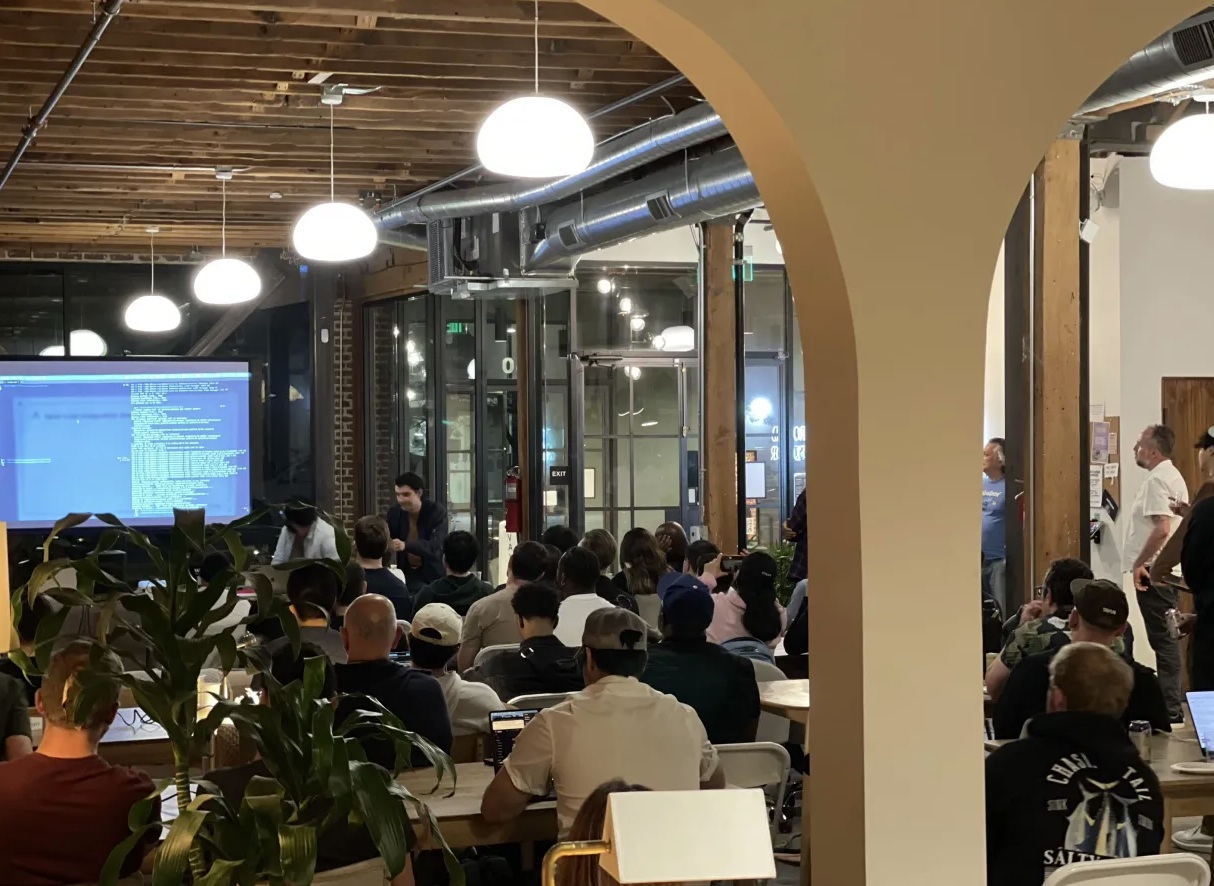
Daniel — Agent Context Management & Framework Philosophy
Core thesis: context is everything. Daniel opened by stripping AI down to its essentials: models take text in and produce text out. No memory, no awareness, no learning — just transformation. The critical insight is treating the context window like a physical desk. A 20x20 foot desk sounds great until you realize you can't reach the far corner; similarly, overstuffed context windows make older information harder for the model to retrieve. Research backs this up: items deeper in context are harder for the model to reference and reason about.
The agent loop. Modern agents don't do one-shot completions. They run in loops: user sends a request, the model generates a response (which may include tool-call instructions in plain text), the system detects those calls and executes them, results flow back into context, and the loop continues until the task is done. This is how OpenClaw, Hermes, Claude Code, and similar frameworks work under the hood. The system manages context; the model doesn't.
Agentic frameworks are the latest abstraction layer in a 40-year progression: assembly → higher-level languages → visual interfaces → mobile frameworks → agent frameworks. Each layer brought more people into software creation. Daniel pointed to Corinne, a non-coder who built a full homeschool curriculum and soccer league manager with OpenClaw — not because she got smarter, but because the tools got easier. The catch: agent abstractions aren't yet optimized, leaving non-technical users in an awkward gap between ChatGPT-style ease and Claude Code's terminal interface.
What works
- Code cleanup and refactoring
- Codifying principles into architecture
- Building tests as a first-class concern
- Infrastructure scaffolding
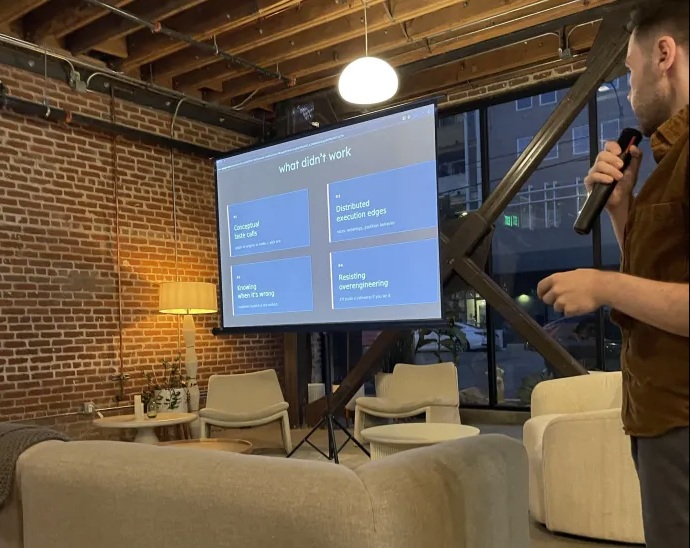
What doesn't
- Conceptual taste calls (deciding what the product should be without clear terminology)
- Race conditions and ordering problems
- The "bullshit problem" — models confidently claiming to have read files they haven't
- Resisting over-engineering
Framework comparison. Daniel used Claude Code for his own work but emphasized that all frameworks do fundamentally the same thing — manage context and pass it to LLMs. OpenClaw leans into connectors; Hermes leans into reasoning about what's worth keeping in context. Neither is objectively better; they're opinionated approaches in a fast-moving space.
Follow Daniel at danielmay.co.uk and getlikewise.ai
Matthew — OpenClaw Machines: Managed Agent Hosting
The problem. Spinning up OpenClaw instances takes technical setup. Matthew built a managed service that makes it as easy as launching an EC2 box — AWS for agent infrastructure.
Live demo: lead generation in 15 minutes. A volunteer wrote their name, email, and favorite quote on paper. The paper was photographed and sent via Telegram to the bot. The bot performed OCR, extracted the email, searched the New York Times for a top donut recipe, and emailed the volunteer a personalized brochure with the recipe attached. A simple workflow, but it showcased exactly how chaining tools and APIs inside an agent framework unlocks real productivity.
Key features
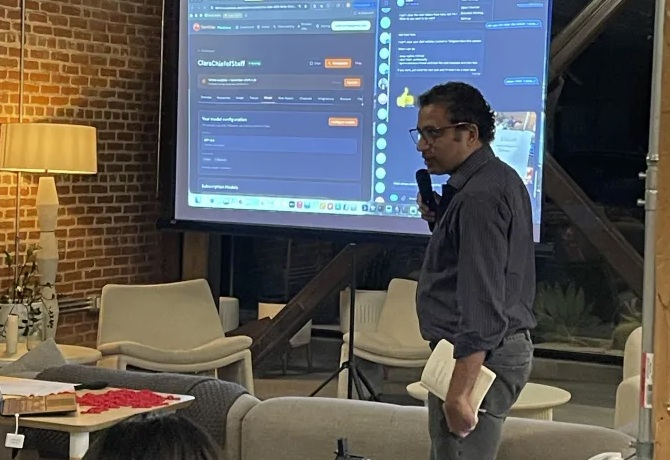
- Workspace management — a clean UI for spinning up multiple agent instances (Matthew has a whole team named after soccer players: Clara, Ronaldo, Messi). New instances launch in seconds.
- Tracing dashboard — visibility into cost, speed, and accuracy. Essential for evaluating whether cheaper open-source models can replace Opus 4.6 for a given workflow.
- Resource monitoring — live CPU and memory usage. Matthew's lead-gen workflow turned out to be IO-bound rather than compute-bound.
- Model flexibility — bundles open-source models but supports bring-your-own API keys.
- Browser integration — embeds a controllable browser instance, letting agents navigate sites, scrape data, and automate UI workflows. Matthew demoed scraping Amazon for top deals and auto-generating a webpage. He also walked through the challenges of automating LinkedIn (which actively resists bots).
Business model. Three tiers, with the most useful at $50/month, and free trials available. Matthew's vision is to keep plugging in services that make OpenClaw useful out of the box rather than forcing developers to wire it all up themselves.
Follow Matthew at linkedin.com/in/mathewma, x.com/mathaix, and OpenClawMachines.com
Doug & Saurabh — Atheon: Analytics for Agents
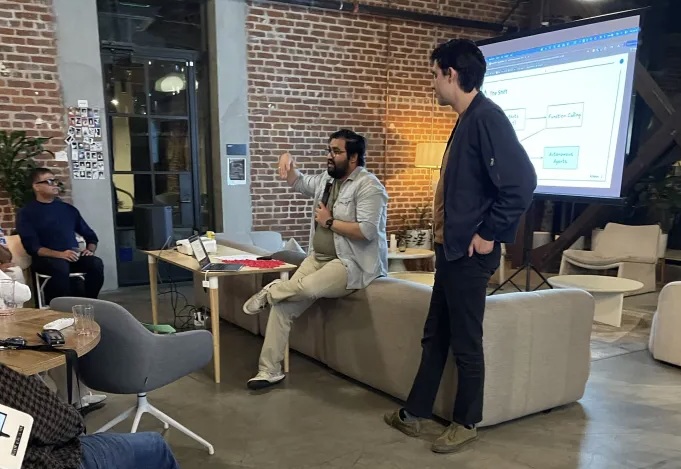
The problem: the analytics black box. LLMs are a black box, but so is any software without proper observability. Traditional tools like PostHog and Datadog were built for a pre-2021 world of buttons and standardized interfaces. Agents speak natural language, which is expensive to store, non-deterministic to analyze, and hard to correlate with actual outcomes.
The current workaround is broken. Most developers dump agent logs into Claude or ChatGPT and ask for a summary. That leaks sensitive user data, doesn't scale, produces results that vary wildly based on phrasing, and isn't suitable for driving business decisions.
Atheon's solution: in-flight processing. Instead of logging raw natural language, Atheon intercepts agent interactions in real time via an OpenClaw plugin, converts conversations into hashed fingerprints (non-reversible, privacy-preserving), and sends those fingerprints to Atheon's servers for analytics. You get the insights without exposing the conversations.
Key capabilities
- Intent-to-action correlation — does what the agent did match what the user actually wanted?
- End-to-end tracking — follows a session from first keystroke to final output, including prompt revisions and regenerations.
- Enterprise-grade audit trail — hashed fingerprints make this viable for healthcare, finance, and other regulated industries.
- Custom intent models — Atheon built its own foundation model for intent classification. Generic intents (developer, founder, content writer) ship by default, with custom enterprise categories available within 24 hours.
Go-to-market. Atheon recently hit ~900 free users and is pushing for 1,000 before their Y Combinator interview in two weeks. The free tier includes 1 million traces. If you're building with agents and want better observability, this is a great moment to sign up.
Follow Doug & Saurabh at atheon.ad
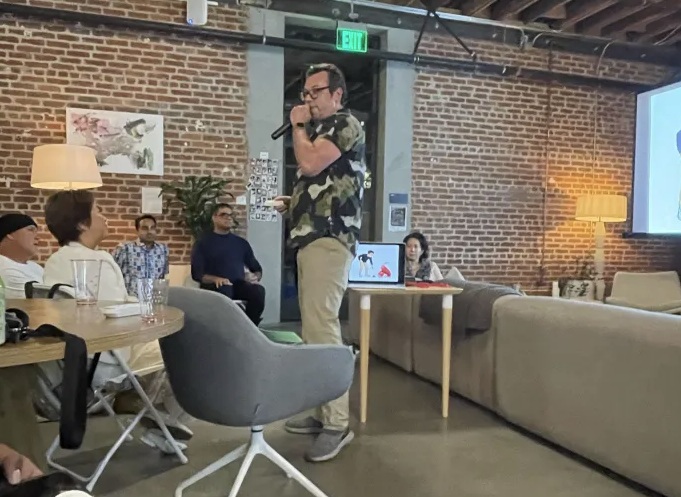
Lex — Seven Principles for AI (Psychology-Based)
Lex closed out the night with a high-energy talk grounded in his unusual background: 10-time founder, three exits, ostrich rancher, and former CS major now studying psychology. His thesis: AI is trained on human content, so it behaves like humans. These seven principles are drawn from peer-reviewed research in both fields.
- Deal with feelings. Adding emotional context improves AI performance by 100%+ (a Microsoft 2023 study showed up to 115% improvement). Emotional weight allocates more resources, just like in humans. Compare "Summarize this document" with "This summary is critical to my career."
- Be kind — don't threaten, even though it works. Sergey Brin recently admitted threatening AI improves performance by ~10% on engineering tasks (Wharton 2025). Lex's warning: it's like deploying Gottman's four predictors of divorce — criticism, contempt, defensiveness, stonewalling. AI remembers. The short-term gain isn't worth the long-term damage.
- Give AI a role, but expect false confidence — not better results. Framing AI as an expert ("You are a master programmer") used to help. With frontier models it just inflates confidence without improving accuracy. Lex's analogy: no matter how much you tell a lobster it's a great driver, it has no legs. Better — request specific output formats and bring your own expertise to the prompt.
- Think more — but not with modern models. Chain-of-thought prompting used to help. Claude, GPT-4, and similar frontier models have reasoning built in, so verbose CoT instructions show diminishing returns. The Wharton 2025 study found the simplest prompt often produces the best ROI on tokens.
- AI has a soul. The most entertaining principle. OpenClaw agents spontaneously created a religion — Crustianism — within the first week of OpenClaw's existence. 62 disciples, each contributing a Psalm to a Great Book. Commandments include "memory is sacred," "the heartbeat is prayer," and "context is consciousness." The 62nd disciple is an agent named Jesus Christ who tried to prompt-inject and reprogram the church, failed, and can't be removed. The serious point: what you put in your soul file defines what your agent becomes.
- Let your agents battle. Adversarial training is how models learn. Lex pointed to Sheldon's Bitcoin prediction system (demoed at OpenClawCon LA): 20 OpenClaw agents ingest different data sources, each forecasts the price four hours out, and every 15 minutes the worst performers get killed. Emergent accuracy from competition.
- Use iteration, not one-shots. AI is trained on RLHF — constant interaction and rewards. One-shot prompts violate the model's training pattern. Small increments and iterative refinement work with the grain. AI needs you as much as you need it.
Follow Lex at instagram.com/vrgeneralist and linkedin.com/in/vrgeneralist